

Best Free SEO Tools for Beginners: What Actually Works
Nobody warns you about the overwhelm. You decide to learn SEO, open three browser tabs, and suddenly you’re drowning in talk of crawl budgets, domain authority, and algorithm updates. Twenty minutes in, you’ve learned nothing and questioned every decision. The good news? The best free SEO tools for beginners give you everything you need to start ranking — without a single subscription draining your budget.
Let’s cut through the noise and cover exactly what works.
Why starting free beats starting expensive
Paid platforms like Ahrefs and Semrush are powerful. They’re also built for people who already know what they’re looking at. Drop a beginner into either one and watch their eyes glaze over inside two minutes.
Starting with free tools forces you to learn the fundamentals yourself — search intent, site indexing, on-page signals — instead of blindly trusting a proprietary score. That instinct carries you further than any dashboard ever will. Once your traffic starts converting consistently, upgrading to paid tools makes sense. Until then, free isn’t a compromise. It’s the smarter starting point.
→ [INTERNAL LINK: “advanced keyword research frameworks” → /advanced-keyword-research-strategies]
The best free SEO tools for beginners — broken down
1. Google Search Console
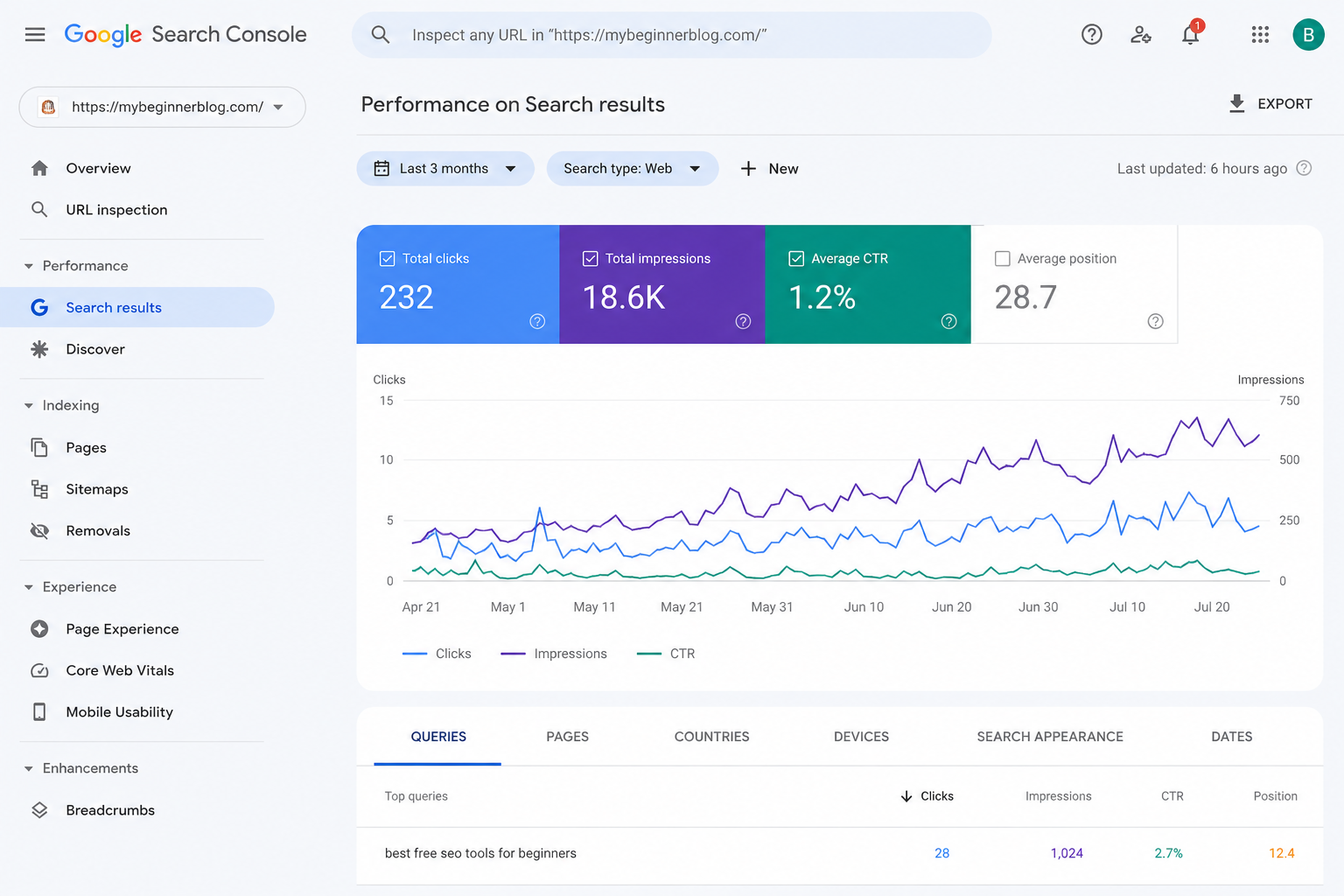
Skip the third-party estimates. Search Console shows you exactly how Google sees your site — real impressions, real click-through rates, real ranking positions for specific queries. No guesswork, no interpolation.
Set it up before you write a single word of content. Submit your XML sitemap, fix crawl errors, and check it every Monday morning. The official Google Search Console doc
umentation walks you through setup in under 20 minutes.
Among all the best free SEO tools for beginners, this one has no real substitute. It’s the difference between optimizing with data and optimizing with hope.
2. MozBar Chrome extension
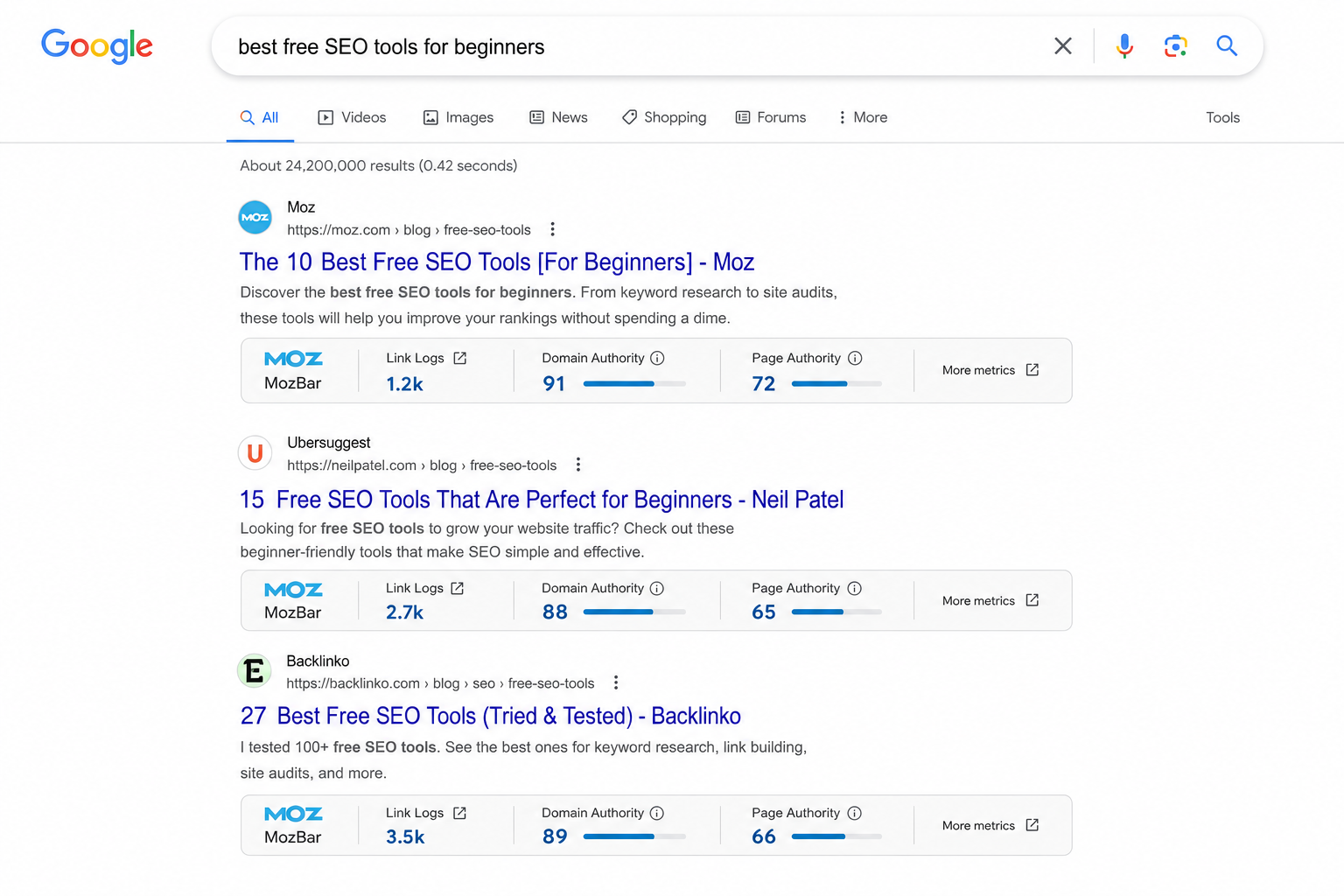
Before spending three hours on a post, you need to know if you can actually compete for that keyword. MozBar is a Chrome extension that shows Domain Authority scores and page metadata directly inside your search results — no separate tab, no login.
If the top five results all have DA scores above 70, a newer site probably isn’t ranking there yet. That’s useful to know before you write, not after. It’s one of the most practical free SEO tools for beginners because it removes the guesswork from competition analysis.
3. AnswerThePublic
Most beginners chase search volume and ignore search intent. A keyword with 10,000 monthly searches means nothing if people searching it aren’t looking for what you offer.
AnswerThePublic pulls autocomplete data from Google and maps it into question clusters — who, what, why, how. It shows you the exact language real people use when looking for answers in your niche. Answer those questions thoroughly and you’re positioned for featured snippets and People Also Ask boxes. HubSpot’s content strategy guide covers how to build an editorial plan around this kind of intent mapping. For deeper keyphrase work, also check Moz’s beginner keyword research guide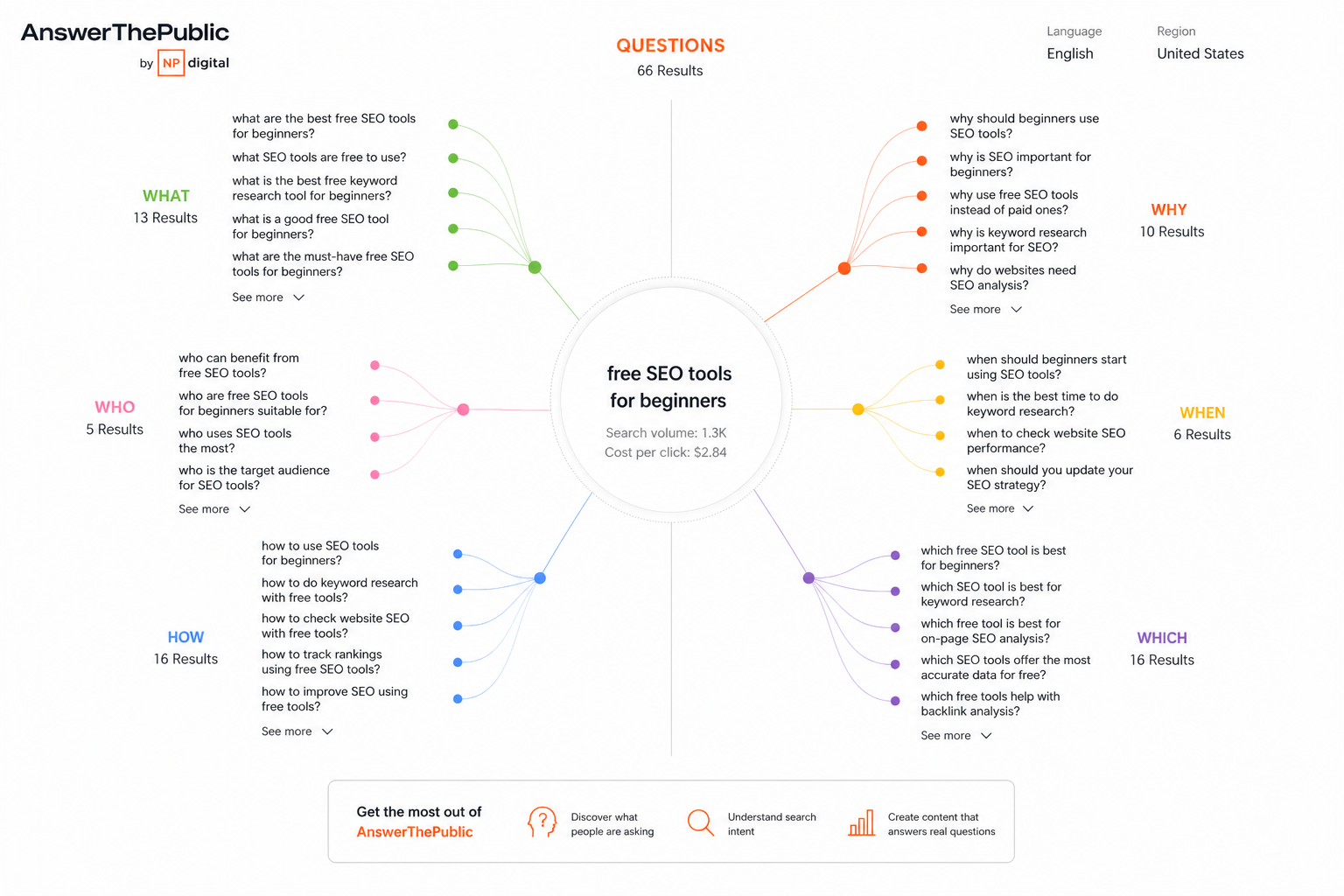
Building a weekly routine with free SEO tools for beginners
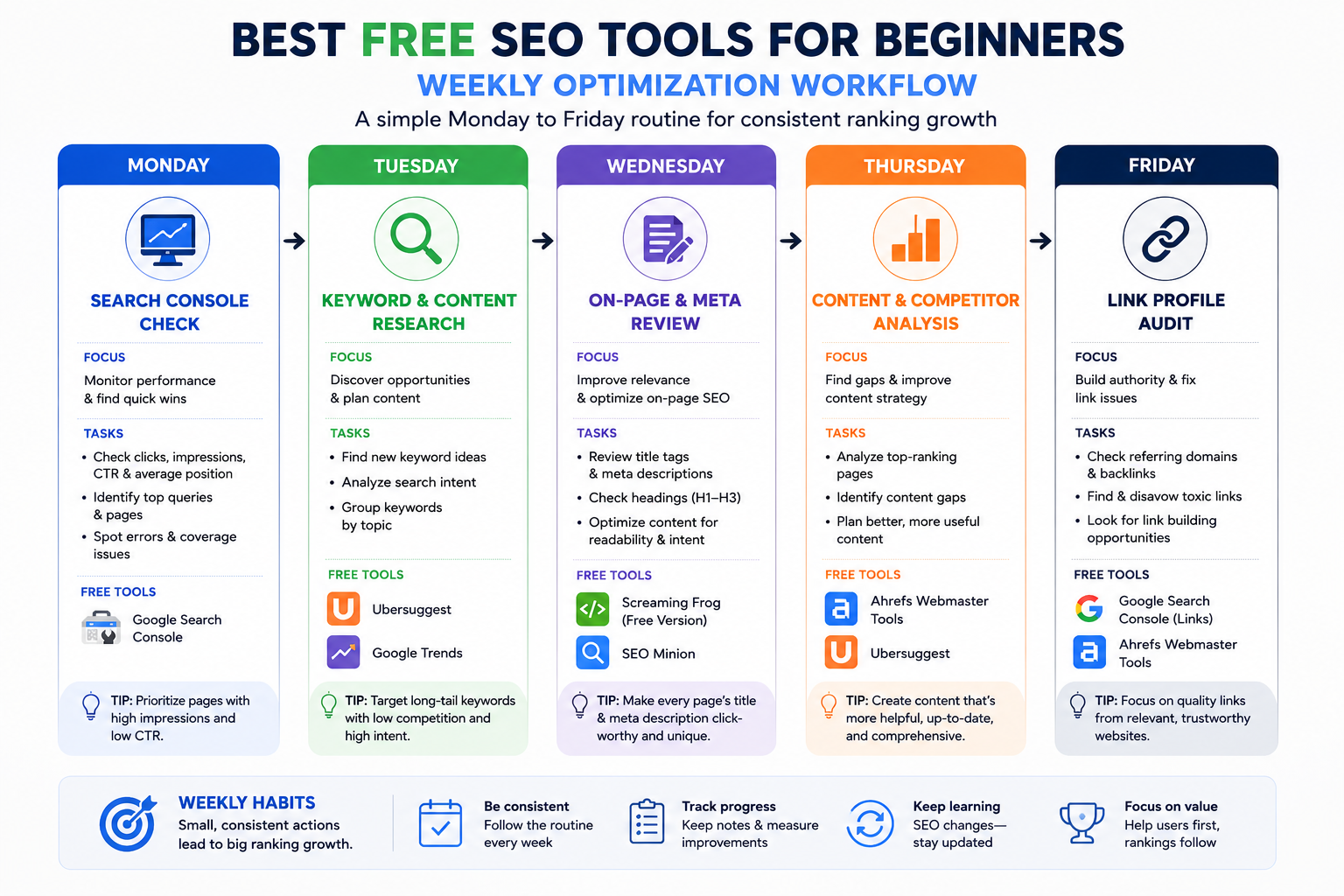
Tools don’t rank pages. Consistent habits do. Here’s a simple three-day-a-week workflow that actually moves the needle.
Monday: Open Search Console. Scan for impression drops or new crawl errors flagged since last week. These are your early warning system — catch problems here before Google demotes you.
Wednesday: Review titles and meta descriptions for two or three pages. Are they still aligned with what people are actually searching? Small copy tweaks here compound over time.
Friday: Audit your internal link structure. Passing authority through smart internal linking is one of the most underused tactics in any beginner’s toolkit.
→ [INTERNAL LINK: “internal linking strategies for blogs” → /internal-linking-strategies-for-blogs]
The honest bottom line
Most people overcomplicate this. They wait for the right tools, the right moment, the perfect strategy. Meanwhile, competitors with simpler setups quietly build traffic.
The best free SEO tools for beginners — Search Console, MozBar, AnswerThePublic — cover the fundamentals completely. Set them up, use them on a schedule, and you’ll outperform most sites spending ten times what you are.
Ready to put this into action? Download our free optimization checklist and start building the habits that compound. If you hit a wall getting your first dashboard configured, drop a question in the comments.